
Our History
Founded by Major-General Charles Edward Luard in 1901, and originally named The Society of Working Men’s Rifle Clubs (1901 - 1903), we have a long and interesting history. We’ve had headquarters in a few different locations over the years and a couple of name changes but our main focus has stayed the same, promoting Small-bore Target Shooting and skill enhancement through competition.
Following a merger with The British Rifle League in 1903, The Society of Miniature Rifle Clubs (1903 - 1947) was born, then in 1947 by Special Resolution we became The National Small-bore Rifle Association.
For some historical stories, check out our Blasts From The Past page
Early Years
A combination of the increasing concern of the Army’s capability to defend against invasion and the surprise at the impressive skill of the Boer’s superior marksmanship against the British troops during the early stages of the Boer War meant a call went out for British civilians to learn to shoot to defend their country, should the need ever arise.
There were few rifle clubs and those that existed were often far from major cities, only used for service-type rifles (full-bore) making it too expensive for most of the population. Gradually service rifles became more easily available to civilians but it was Major-General Charles Edward Luard who drove forward the belief that civilians could learn to shoot just as well with ‘miniature’ rifles (small-bore). These were very affordable and range safety requirements were easier to satisfy, making it much more accessible to the general public.
Major-General Luard gained the backing of several notable figures including the most influential national hero of the time, Field-Marshal Frederick Sleigh Roberts, Earl of Kandahar, Pretoria and Waterford. With this additional support, General Luard called a meeting on 23rd March 1901, chaired by Sir Frank Green (Lord Mayor of London), and attended by the Lord Mayors of York and Liverpool, Members of Parliament and officials of the Federation of Working Men’s Social Clubs, the Federation of London Working Boys’ Clubs, and the Association of Conservative Working Men's Clubs. It was here the Society of Working Men’s Rifle Clubs (SWMRC) was formed.

General Luard
Photo courtesy of the 1906 publication of The Rifleman
Society of Working Men’s Rifle Clubs
Earl Roberts had been given Presidency of the Society, and a committee was appointed under the Chairmanship of Major-General Luard. A badge, consisting of a Maltese Cross on a wreath of laurel leaves, was designed and the General's family motto, in its anglicised form, "LOOK FORWARD", adopted. The General enthusiastically set about making the Society a success. He had invented, for indoor use, a target apparatus which he named the "Ian Hamilton Range" after his friend, Major-General Sir Ian Standish Monteith Hamilton. The device, a combination of stop-butt and holders for moving and disappearing targets, demonstrated Luard's emphasis on training in sharpshooting, which he believed to be the most likely form of shooting that would be required in the field.
Towards the end of 1902, there were nearly 80 clubs affiliated to the Society and preparations were going ahead to hold the first shooting meeting. Both the British Rifle League and the SWMRC combined their efforts to create the first Meeting, held at the Crystal Palace late in March 1903.
In May 1903 the British Rifle League and The Society of Working Men’s Rifle Clubs merged to form The Society of Miniature Rifle Clubs (SMRC). The Society set up a Limited Company with Henry Fitzalan-Howard, 15th Duke of Norfolk becoming the first Chairman of Council whilst General Luard remained Chairman of the (Executive) Committee.
Although Major-General Luard had the honour of founding the Society, it was the tireless enthusiasm of Lord Roberts over a ten year period, urging the formation of civilian rifle clubs in every town and village in the country, that built the foundations of the small-bore shooting sport of today.

Field-Marshal Lord Frederick Sleigh Roberts
Photo courtesy of The Rifleman publication
Beginnings of The Rifleman & County Competitions
1906 saw the first publication of The Rifleman, and the announcement of the parting of ways of the SMRC and Major-General Luard, who believed the greater emphasis on deliberate prone shooting was not in harmony with the SMRC’s original reason for being. Later in the year, Lord Roberts instigated the SMRC to be officially recognised by the Army Council and accorded equal powers and privileges to the National Rifle Association (NRA), including exemption from liability for payment of Gun Licence Duty by members of affiliated clubs. As the cost of a Gun Licence was quite expensive at the time (ten shillings per year) this was a major incentive for the advancement of the sport.
In 1907 the Society drove the formation of County Associations, gaining further incentive on 7th February when "The Queen's Cup" was presented by Her Majesty the Queen to the SMRC for competition amongst the Counties of the United Kingdom. The proposed format was a team of ten from each county, but as most counties had not yet formed their own associations, the format was changed to an initial stage where all club members could enter and for the final two stages each county put forward one person to compete. Only Huntingdonshire was not represented. A.G. Banks of Southport, representing Lancashire, was the first winner and he received the cup and a gold medal personally from HM the Queen at Buckingham Palace.
Three years later, in 1910, the conditions reverted to the original idea of county teams, but of six and not ten members. Middlesex emerged as the winners of this first Inter-County Team Competition which, following the death of King Edward VII that year, was re-named The Queen Alexandra's Cup Competition.

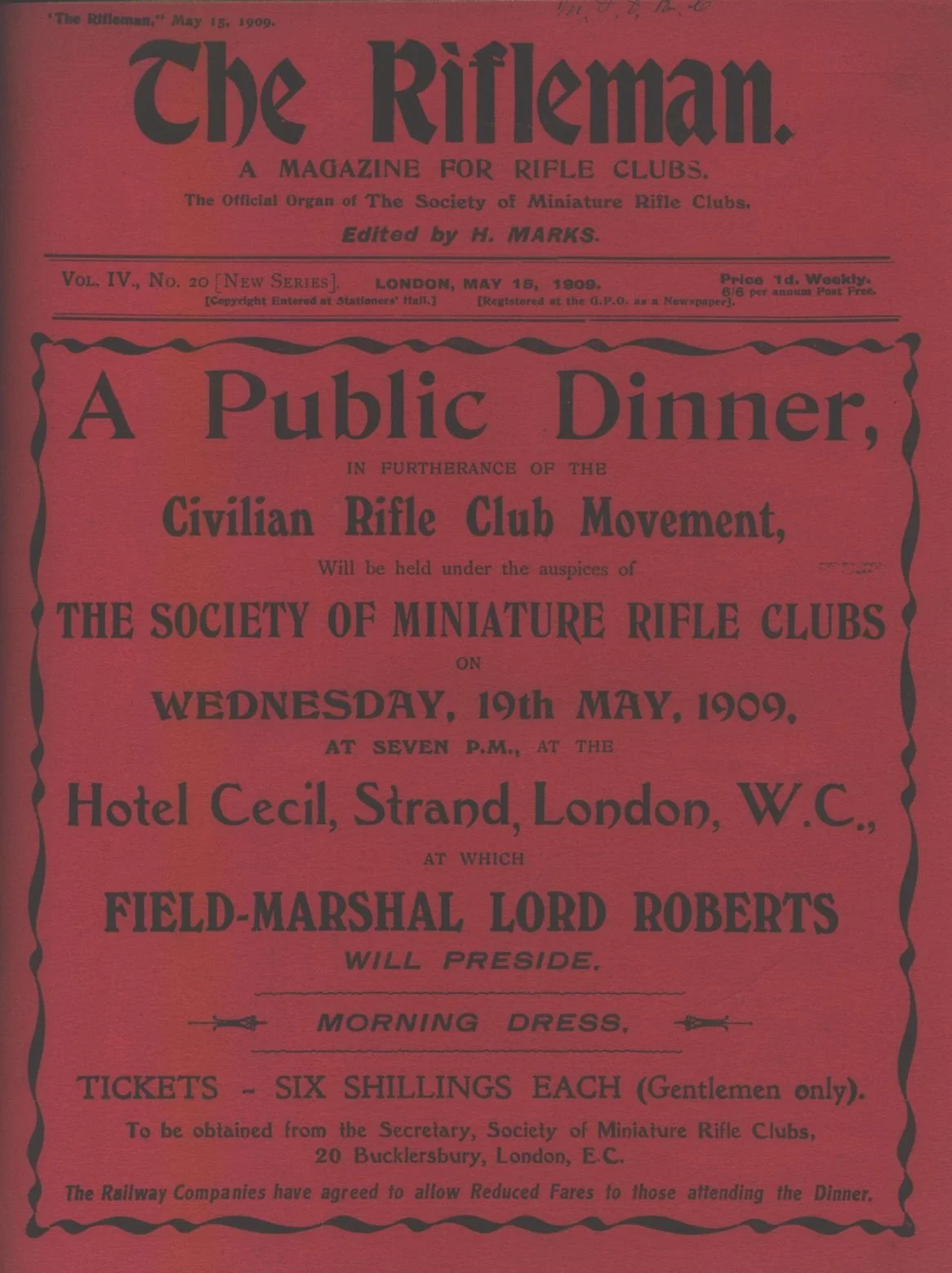
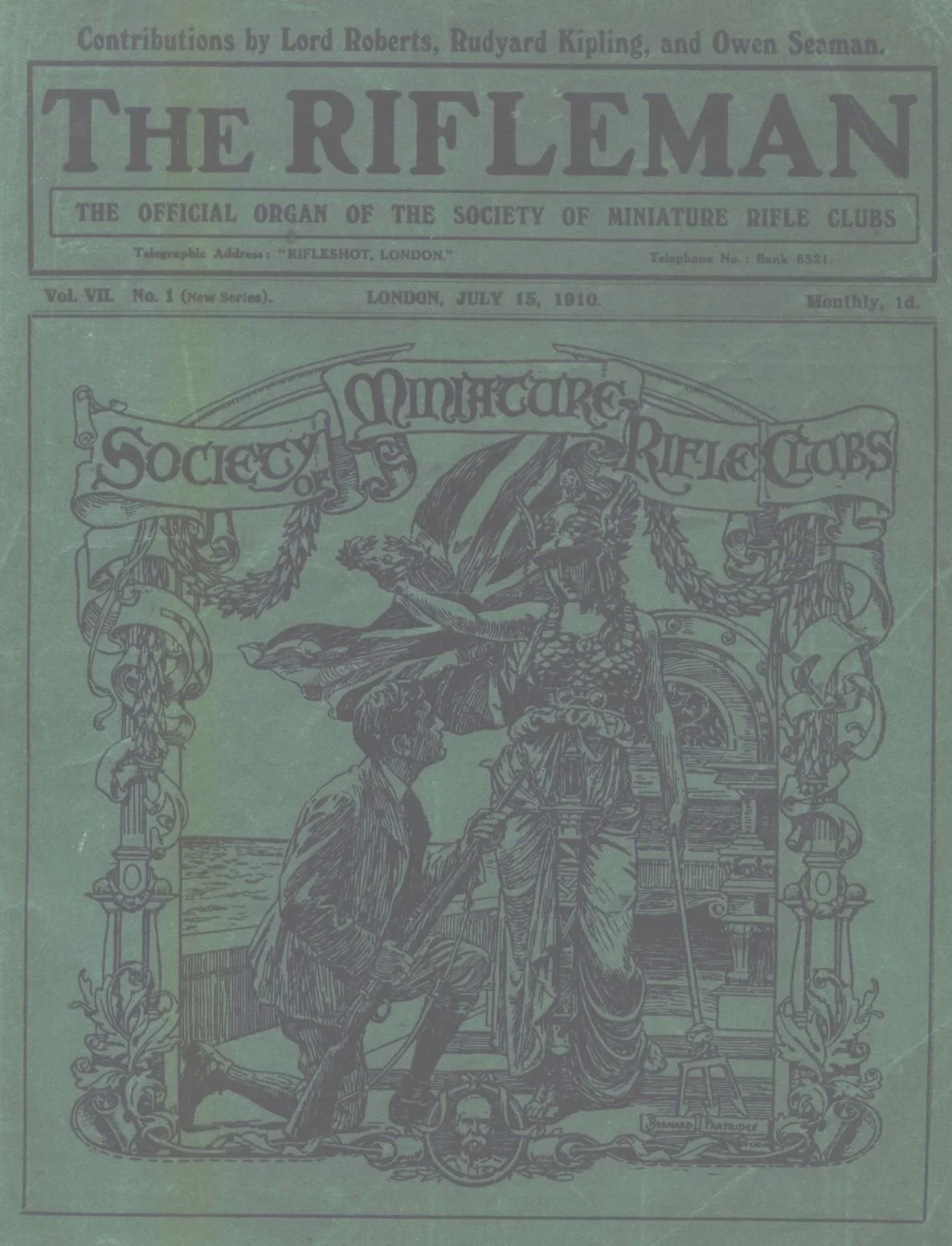
The Rifleman - Volume 1 from 1906 plus a front cover from 1909 (red) and 1910 (blue)
Photos of 1909 and 1910 covers courtesy of Brian Woodall
Fallen Founder, War and the SMRC
Following the death of Major-General Luard in 1908 his newly formed The Patriotic Society merged with the SMRC who gained six of their trophies, the Patriotic Shields, which continued to be used for competitions.
By the outbreak of war in 1914 the SMRC’s affiliated clubs had taught many thousands of civilians to shoot, and they were ready to take up arms in military service. Sadly, Earl Roberts (now 82), died while visiting troops during the First World War. His body was laid to rest in a state funeral at St. Paul's Cathedral on 19th November 1914.
The SMRC appointed a new President in Field Marshal Sir Douglas Haig in 1917.
Following the Armistice of 1918, the post war years were a difficult time for the Society; many club members had lost their lives in the conflict and, with the introduction of legislation in the form of the 1920 Firearms Act, enthusiasm for shooting waned. Affiliated Clubs fell to just 1,500, but hard work and dedication by a small staff, led by George Pethard as Secretary, slowly revived interest during the inter-war years.

Field-Marshal Douglas Haig, Earl of Bemersyde
Photo courtesy of The Rifleman publication
Quest for a Range and Formalisation of the Air Rifle Section
During its time, the Society moved to different locations within London as it outgrew its previous accommodation, including Victoria Street, Bucklersbury, Arundel Street and, in 1929, settled at Codrington House in Water Lane (later renamed Blackfriars Lane) which became its Headquarters for some time.
In 1920 a site of just over six acres at Perivale, West of London, was purchased at a cost of £2,500, with the intention of establishing a National Small-bore Range, together with the Society's Headquarters. It already had a partly built stop butt (at Government expense), and plans went ahead to hold the 1921 London Meeting on the new range. However, this was not to be. Although some progress was made, little support was received in additional funding, and in 1933, the land was sold ending our first attempt to set up our own 'National Range'.
In 1924 Douglas Oakey had been appointed S.M.R.C. Travelling Representative for the Southern Counties. He was provided with a "Motor Van Show Room", becoming a familiar sight delivering shooting requisites and offering advice to clubs in his area. In 1933, Tom Walker began carrying out similar activities in Scotland, driving his "wee" Austin 7.
1929 saw a formalised a National Air Rifle Section within the Society, and by 1939 the number of affiliated organisations totalled 2,374 Clubs, 77 Local Leagues, 60 County Associations and 13 Overseas Associations.

Mr Douglas Oakey with the SMRC branded van
Photo courtesy of The Rifleman publication
War Once More and a Change in Patronage
1939 saw the country at war again, with several members of the staff leaving to join the forces. However, the number of affiliated Clubs increased with the formation of the Local Defence Volunteers, soon re-named the Home Guard, many of our present Clubs can trace their origins back to "Dad's Army".
Disaster struck on the night of l0 - 11 May 1941 when, during the heaviest air raid on London during six years of war, the SMRC headquarters, Codrington House, was totally destroyed. There were no staff in the building thankfully, but the Society's records were lost along with 45 of the Challenge Trophies. Six of the larger and more valuable trophies did survive, among them the Queen Alexandra Cup and the Chas R. E. Bell Trophy, which had been placed in the bank vaults.
Having been favoured with the Royal Patronage of Field Marshal HRH Prince Arthur, Duke of Connaught and Strathearn for nearly forty years until his death early in 1942, a further royal accolade was received on 27th April 1942 when His Majesty King George VI granted his Patronage to the SMRC.
By 31st December 1945 there were 4,019 affiliated clubs and other organisations, of which 1,012 were former Home Guard Units. Although having been stood down during 1944, the War Office announced that it would "assist in continuing the comradeship of the Home Guard through the formation of rifle clubs". The Society again assisted with training and range certification work and, as in 1914, tribute was again paid by the Secretary of State for War in the House of Commons, for the work carried out by the SMRC.

First page of the SMRC Handbook, 1911
A replacement presented by W Cornish
Changing Venue and Changing Names
Following an agreement with the NRA, another landmark was reached when, on 1st July 1946, the Society assumed control of .22 pistol shooting.
On 8th March 1947, after 44 years, the SMRC changed its name by Special Resolution, to The National Small-bore Rifle Association (NSRA). The Society's motto "LOOK FORWARD" continued as did the heraldic "Royal Crown", which is still used today.
Our Patron changed in 1952 when Her Majesty Queen Elizabeth II, following her accession, continued the Patronage bestowed by her father, His Majesty King George VI.
In 1953 the NSRA moved to 113 Southwark Street, London and named it Codrington House.
The quest for a permanent range for small-bore shooting was taken up by General Sir Lashmer Whistler, in 1959 when he became Chairman, but despite strong efforts, a Whistler Range was never realised. However, with financial assistance from the Sports Council, a demountable 'National Range' was constructed for use on the Bisley Century Range for our Rifle Meetings and used for the first time in 1977.

Coming Home and Branching Out
With Bisley known as the Home of Shooting and being developed as a National Shooting Centre, the decision was taken to move out of London and establish the Association's Headquarters within Bisley Camp.
The old "Roberts Hut" site was purchased from the NRA and, financed by the sale of the Southwark Street premises for £145,000, a new "Lord Roberts House" was built, just within the camp boundary, opening for business on 5th February 1980.
With the less restrictive appeal of air gun shooting, the NSRA as the Governing Body for Air Gun and Match Crossbow Shooting, established a purpose built National Indoor Shooting Centre at Aldersley, Wolverhampton (now known as NSRA Aldersley). This facility, opened in 1991, provided a more central location for the British Air Gun Championships (held there between 1992 – 2001)
2001 saw the creation of the Lord Roberts Centre (LRC) at Bisley Camp, constructed for the 2002 Commonwealth Games. NSRA Bisley now serves as the NSRA’s headquarters and, with its multi-disciplinary ranges, as a hub for teams and clubs to train.
Regular competitions from club to international level are hosted at NSRA Bisley with the exception of the NSRA’s Bisley National Rifle Meeting. A summer spectacle and NSRA tradition since 1922, the Bisley National Rifle Meeting is an impressive event held on the NRA’s Century Range which is rented for the event duration. It is one of the highlights of the target shooting calendar, where people come together from across the world in the spirit of competition and camaraderie.

New Patron

You can find a more detailed version of our history, pre-1992, here
In May 2024 the NSRA was honoured to receive confirmation that His Majesty King Charles III would be our new Royal Patron, carrying on the Royal Family’s ongoing support of the Association.